
How to Play
How to play Lorum
Introduction
Lorum is a four-player compendium card game. Instead of one set of rules for the whole evening, you play a list of short contracts — trick-taking rounds, then layout or counting rounds.
Most contracts are about avoidance. A few reverse the aim. After you play the list, the lowest total usually wins. Each contract asks for a slightly different strategy: some are more for laughs, while others can be quite serious.
Players
The usual game is four people, each playing for themselves. The online table can mix human seats with computer opponents, or pass one device around a physical table.
Cards
Players use a 32-card pack: Ace, King, Ober (Queen), Unter (Jack), 10, 9, 8, 7 in four suits. The online game also lets you use a 52-card deck.
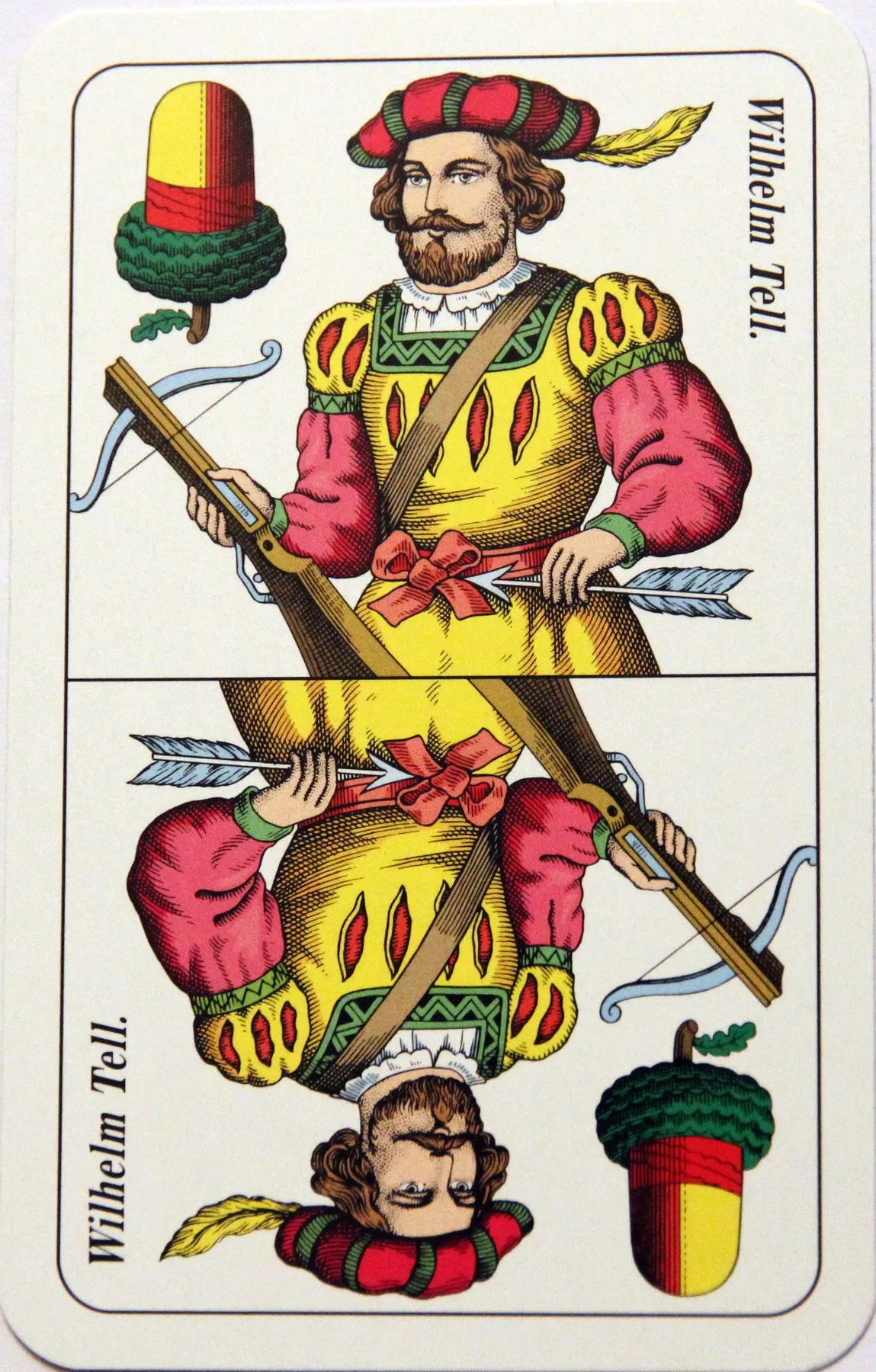
The traditional pack is German-suited — Acorns, Leaves, Hearts, and Bells — often in the Hungarian William Tell pattern. Many tables use French-suited cards (clubs, spades, hearts, diamonds) instead; Ober maps to Queen and Unter to Jack.
Standard trick-taking rounds have no trumps. Rank order is natural: Ace high, Seven low.

Objective
Win the match with the lowest score. Individual rounds award penalty points in different ways — per trick, per card, for a single dangerous card, or for cards left in hand.
How a trick works
- Who leads
- The player after the dealer leads the first trick. After that, the winner of a trick leads the next.
- Following suit
- You must follow the suit led if you have it. If you do not, you may play any card.
- Winning the trick
- The highest card of the led suit takes the trick. Off-suit cards never win, and there are no trumps.
- Who leads next
- The winner of the trick gathers it and leads to the following one.
of led suit
Rounds
A Lorum match is a list of contracts. The objective can change from round to round: dodge hearts, dump the Red King, then race to empty your hand. Groups keep different lists; the online game lets you pick a Czech or Hungarian set, or customise your own.
Scoring
You add penalty points after each contract. Taking the thing the round forbids is what costs you.
Traditionally the lowest cumulative score wins. Some house rules pay chips into a pot instead of writing numbers; the standing is the same idea.
Exact values — how much the King is worth, whether leftover cards cost one point or more — belong to the table’s rule set.
Now that you know the basics, try a game.